Trekking Mount Pinatubo in the Rainy Season
Short answer. June to November is the rainy season and the trail runs less reliably in it. What closes the day is water in the riverbed rather than rain on your head. Book with the free-cancellation window, keep a spare day, and expect a longer walk. In exchange you get green walls, cloud in the caldera and an empty trail.
Every guide to this mountain tells you to come in the dry season, and every one of them is right. This one is for the people who cannot, which is most of the northern hemisphere's summer holidays and a good deal of business travel.
What the rainy season actually is here
PAGASA puts the Philippine rainy season at June to November and the dry season at December to May, splitting the dry half into cool months to February and hot months from March. On Clark's 30-year climatological normals — the nearest station to the Capas jump-off — that split is stark: 17.4mm of rain in January against 429.4mm in August.
Why does rain close this trail and not others?
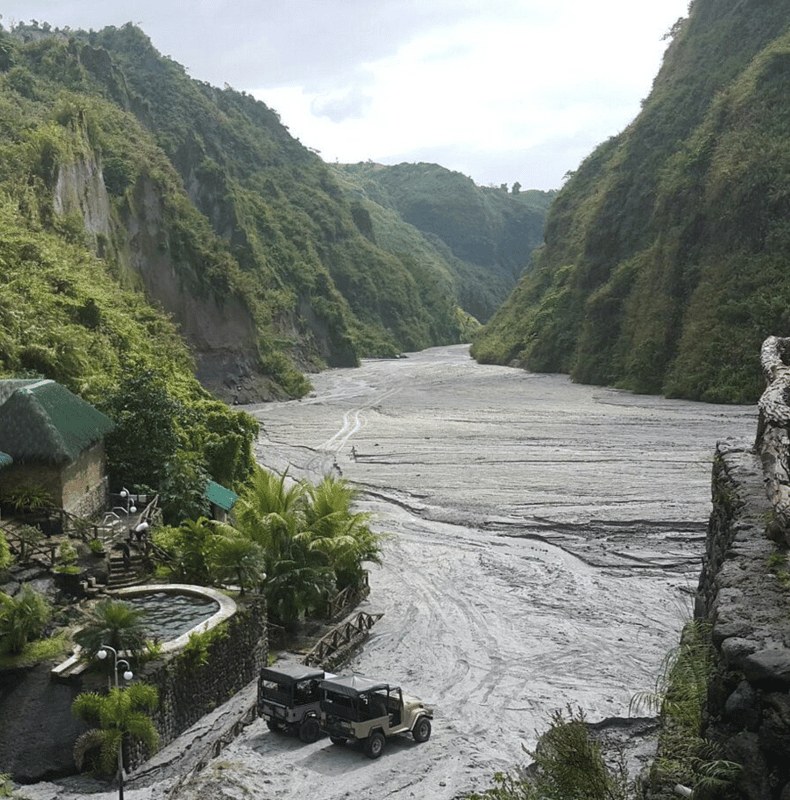
Because the approach is a riverbed. The 4x4 drives up it and the walk follows it, and both cross running water. Rain falling anywhere upstream raises that water within hours, and the ground either side is loose ash rather than rock. It is not the gradient, the exposure or the visibility that stops a Pinatubo day. It is the crossings.
That is also why a wet morning in Manila tells you nothing. The decision is made at the jump-off by people looking at the water.
June to November, month by month
PAGASA 30-year normals for Clark, Pampanga. On the western side of the range the figures are far higher: Iba, in Zambales, averages 897.7mm in August alone.
| Month | Rainfall, Clark | What it does to the day |
|---|---|---|
| June | 241.2 mm | Season opens; jeeps stop lower, the walk gets longer |
| July | 422.6 mm | Cyclones cross Luzon; stand-downs become common |
| August | 429.4 mm | The wettest month; the riverbed can be impassable for days |
| September | 293.1 mm | Easing but unreliable; the walls are at their greenest |
| October | 177.0 mm | High in the first fortnight, settling in the second |
| November | 78.0 mm | Effectively dry-season ground with none of the crowds |
What changes on the day
- The jeeps stop lower. Which makes the walk longer, sometimes considerably.
- The crossings are deeper. Ankle deep in the dry months, higher and slower after rain.
- The surface changes. Dust becomes mud, which is better for your lungs and worse for your footing.
- The schedule slips. A longer walk in and out eats the time at the crater first.
- The call can come late. Stand-downs are decided on the morning, at the jump-off.
How much longer is the walk?
Anywhere between half an hour and an hour extra each way, and the variable is entirely where the jeeps stop. In the driest weeks they push well up the riverbed and the trail is close to an hour; after sustained rain they stop lower, the bed is softer and the crossings are slower, and the same route becomes two hours. Reviewers quoting three kilometres and reviewers quoting five are both telling the truth about different months.
That difference lands on the time you get at the crater rather than on the return, since the return is fixed by the drive home. A longer walk in is an hour at the lake instead of ninety minutes, and it is worth knowing before you plan a picnic up there.
What you gain
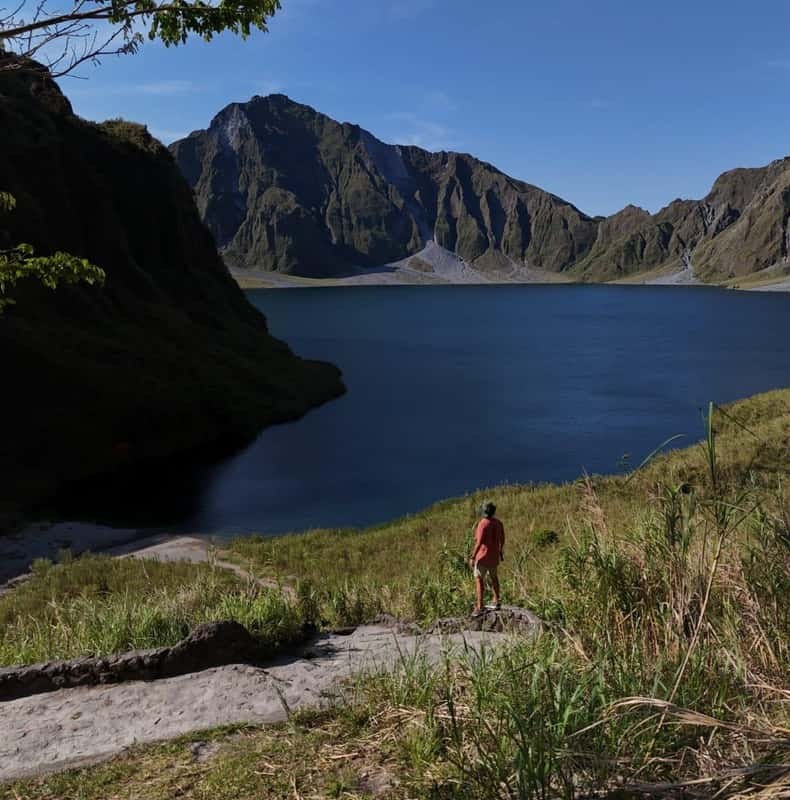
Three things, and they are not consolation prizes. The caldera walls are green rather than grey, which is a genuinely different photograph from the one everybody has seen. Cloud sits in the crater and moves through it, which the dry months never give you. And the trail is empty: no queue at registration, no convoy of jeeps ahead of you, and the shore to yourself.
There is also no dust, which anyone who has ridden three hours behind another 4x4 in February will tell you is worth something.
Is it worth booking in August?
Only with a spare day. August is the wettest month on the record and the riverbed can be shut for several days at a stretch, so a single fixed date in August is a coin toss. If you have a week in the country and can try twice, it is a reasonable bet. If you have one morning between flights, it is not, and the honest answer is to spend that morning somewhere else.
What makes any of this rational is the cancellation window: every day listed here refunds in full up to 24 hours before the start.
Book the earlier date, not the later one. If you have two possible days, book the first. A stand-down on day one still leaves you day two; a stand-down on your last morning leaves you nothing. What the day involves covers the timings you are working within.
What does a stand-down actually look like?
Undramatic. You either get a message the night before or you arrive at the jump-off and the jeeps are not going. There is no queue, no argument and no attempt to run half of it: the registration desk simply does not dispatch. Operators who have been doing this for years read the water rather than the sky, and a bright morning after a wet night is exactly the situation in which the trail stays shut.
What follows depends on your booking. Inside the 24-hour window a cancellation is not refunded, which is why the useful move is to watch the forecast from three days out and move the date early rather than turn up hopeful. Outside it, you get the money back. Some operators will offer to shift you to another day instead, and if you have the time that is usually the better outcome for everybody.
Typhoons, and what they mean for a booking
Tropical cyclones cross Luzon most often between July and October. A typhoon anywhere near the region closes the trail well before it arrives and for a day or two after it has passed, because the water takes time to fall. This is not a Pinatubo-specific hazard and it is not something an operator can work around; it is simply the weather the archipelago gets.
The practical response is the same as for ordinary rain: book refundably, watch the forecast from three days out, and move the date rather than hope.
Crater or hot spring in a wet month?
If your dates are fixed inside June to November and you only get one attempt, the hot-spring day is the more reliable booking. It is shorter, lower and does not depend on a long riverbed crossing, so marginal weather stops it far less often. Warm pools in warm rain are also a perfectly good way to spend a wet morning, which cannot be said of a five-kilometre walk on ash.
If you have two attempts, book the crater first. It is the day people come to this mountain for and the wet-season version of it — green walls, cloud in the caldera, nobody else on the shore — is the better photograph. Keep the hot spring as the fallback rather than the plan, and you have covered both outcomes without paying twice for the same weather.
How to pack differently for a wet month
- Shoes that drain, not boots. True in every month and non-negotiable in these ones.
- A dry bag or a sealed pouch. For the phone and the cash, which you still need.
- A light waterproof rather than a heavy one. It is warm rain.
- A full change of clothes in the van. Not optional now.
- Less dust protection. The one thing you can leave at home.
What the wet months do to the rest of the region
Worth a sentence, because a stand-down does not have to end the trip. The same rain that shuts the riverbed fills the waterfalls on the Zambales side and turns the whole range green after months of grey, and Angeles City and Clark are an hour away with hotels, food and an airport. If your Pinatubo day falls through, the region is not short of a Plan B, and none of it requires the trail to be open.
The alternative when the crater is shut
The hot-spring day. It runs on the Pampanga side of the mountain, up its own canyon, and it is a shorter and lower-lying trip that stands a better chance in marginal weather. Warm pools in the rain are not a hardship, and it collects from your own address rather than a forecourt. It does not reach the caldera and never claims to, but on a week when the crater is closed it is the difference between seeing this mountain and not. What else is on this mountain covers the rest, and None departures are on Mount Pinatubo Tours.
Frequently asked questions
Can you trek Mount Pinatubo in the rainy season?
Yes, when the water allows it. Operators run through the wet months and stand down when the riverbed crossings are too high, and that call is made on the morning at the jump-off.
Which is the worst month?
August, on the record. PAGASA's normal for Clark is 429.4mm, and the western side of the range is far wetter still. September is close behind.
Will I get a refund if the trail closes?
Yes. Every day listed here refunds in full up to 24 hours before the start, which is exactly why booking a marginal date is reasonable as long as you do not leave it to the last night.
Is the crater lake worth seeing in the wet months?
Yes, and it looks different: green walls, cloud moving through the caldera and nobody else on the shore. The problem is access rather than scenery. The crater lake page has what you are looking at.
What is the best wet-season month to try?
October, and November if you count it as wet at all. Rainfall drops about 40 per cent from September, the last cyclones cross early in the month, and the riverbed settles through the second fortnight.
Is there a Mount Pinatubo option that still runs when the crater is closed?
The Puning Hot Spring day is the better bet in marginal weather: a shorter, lower-lying trip up its own canyon on the Pampanga side, collected from your address. It does not reach the caldera.
Days that run through the wet months
Mt.Pinatubo: Hike Day Hike only from MANILA PRIVATE TOUR
Private groupPickup includedMountain fees covered
From $382 per person