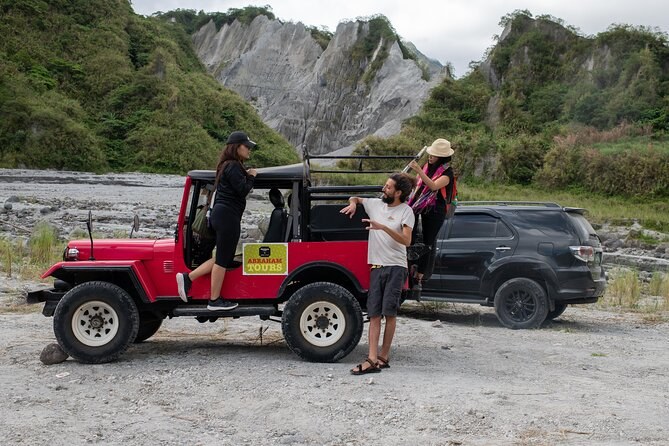
Mt. Pinatubo Day Tour from Manila
Transport includedMountain fees coveredLicensed guide
From $107 per person
This is the straight answer to a question most travel pages answer with a sales pitch. Going independently is legal, normal and cheaper on paper. Whether it is better depends almost entirely on how you are getting to Barangay Santa Juliana at six in the morning.
Yes, with one large caveat. The trek runs through operators accredited by the local government, and the 4x4 that crosses the riverbed is hired at the jump-off from the barangay fleet. You cannot bring your own vehicle onto the plain and you cannot walk in from the road. So "doing it yourself" means getting yourself to the registration desk and buying the rest of it there, rather than arranging nothing at all.
The Capas trail reopened on 23 June 2025 after a suspension over trail maintenance and ancestral-domain matters, and access now runs on that accredited footing. That is worth knowing before you plan around an older blog post.
Three routes, in descending order of practicality. Drive: NLEX to SCTEX, the Capas exit and the barangay road, about three hours from Metro Manila in the small hours. Bus: a northbound service to Capas town on the MacArthur Highway, then a tricycle or jeepney to the barangay, which is cheap and does not get you there before dawn. Or stay locally: the homestays at the jump-off exist precisely so that people can be on the plain at six without driving through the night.
That third option is the one most independent trekkers actually use and the one nobody mentions. Getting to the jump-off has the road times.
Arrive early. Registration is at the barangay tourism desk, fees are paid there in cash, the jeep is assigned and a guide is allocated to your group. Then you wait for the dispatch with everyone else. The process is straightforward and the people running it do it every morning.
What catches people is the cash. There is no machine at the jump-off and nothing there takes a card, so whatever the fees are that week, you need them in pesos before you leave Capas town.
Because the number moves and nobody official publishes it in a form that stays current. The structure is stable: a per-jeep charge shared by up to five, a per-group guide fee, and per-person environmental and conservation fees. The amounts are set by the local government units on each side of the mountain and they have changed more than once.
Blogs quote figures that disagree with each other, and a peso number copied onto a travel page and left to age is worse than none at all. What you can rely on is the shape of it: bring more cash than you expect to spend, and expect to pay in three places rather than one. What the day involves sets out who charges what.
Here is the real comparison. A booked day and an independent day cost roughly the same once you have hired the jeep, paid the fees and got yourself north. What differs is who drives the three hours at midnight, and who stays awake for the three hours home after a five-kilometre walk in the sun.
If you are two people with a hire car, that is a genuine safety consideration rather than a comfort one. If you are a group of five splitting a jeep and one of you is happy to drive, independent is straightforwardly the better deal.
The roads are fine. NLEX and SCTEX are modern expressways and the traffic at one in the morning is nothing like the traffic at nine. The last stretch, from the Capas exit through the barangay to the jump-off, is narrow, unlit and shared with agricultural vehicles, and it is the part to slow down for rather than the expressway.
The real hazard is not the road, it is the return. You will have been awake since the previous morning, walked five kilometres of riverbed in strong sun, and be facing three hours south in afternoon traffic. Every year people underestimate that leg. If your group has one driver and no way to share it, a booked day is not a convenience purchase; it is the safer arrangement.
Two ways to remove the problem entirely: sleep the night before at Angeles City or at the jump-off, or split the driving between two people who have each had some sleep.
This is where going alone makes most sense. Angeles City is an hour from the jump-off, full of hotels, and the base most independent trekkers use. Stay there the night before, leave at four or five, register at six, and you have removed the entire argument for booking a tour: there is no three-hour night drive left to outsource.
It is also the approach that makes a second day at Puning Hot Spring easy, since the resort is on the same side of the mountain. What else is on this mountain covers it.
The jeep, the guide and the fees are the same either way. The difference is the road.
| Independent | Booked day | |
|---|---|---|
| The 4x4 | Hired at the jump-off | Hired at the jump-off, prepaid |
| The guide | Assigned at registration | Assigned at registration, prepaid |
| The fees | Cash, on the day, amount unknown in advance | Prepaid on most listings, or itemised |
| The drive north | Yours to arrange and to stay awake for | Included |
| The timing | You must be at the desk by first light | Built around the dispatch |
| If the trail closes | You have already travelled | Free cancellation to 24 hours before |
| Accreditation | You deal with it at the desk | Handled before you arrive |
More than the booked one, and that is the honest accounting. You add the planning — working out the bus or the drive, finding out whether the trail is open, deciding where to sleep — and you add the hour at the registration desk that a tour has already handled. None of it is difficult and all of it is time.
Against that, you remove a fixed departure and a fixed return. An independent group leaves when it wants, sits at the crater for as long as the guide allows, and drives home when it is ready. On a mountain where the booked day is timed around a shared van, that is a real freedom rather than a theoretical one.
When you are a group of four or five who can split a jeep. When you are already staying in Angeles City or at the jump-off. When you want to set your own pace at the crater rather than travel with a party. And when you have a spare day, because the single biggest risk of an independent trip is arriving on a morning the trail is shut and having no refund to fall back on.
When you are alone or in a pair, because the jeep cost does not divide. When you are starting from Metro Manila without a driver. When your dates are fixed and the weather is marginal. And when you are travelling on a foreign passport at short notice, since at least one operator asks for fifteen days' notice on its own bookings, which suggests the paperwork is not always instant. In any of those cases a Mount Pinatubo trekking tour does the work for a difference in price that is smaller than it looks. Every listed departure is on Mount Pinatubo Tours.
No. You can drive to the barangay jump-off, but the riverbed crossing is restricted to the accredited 4x4 fleet hired there. That rule is the reason every version of this day, booked or independent, involves the same jeeps.
Yes, and one is allocated at registration. The route follows a riverbed that changes shape every wet season, and the guide is also the person who decides whether the crossings are safe on the day.
More than you think, in small notes, because the fees are set locally, collected at the desk and paid in pesos. There is no cash machine at the jump-off and nothing there takes a card.
On paper, and less than people expect. You still pay for the jeep, the guide and the fees; what you save is the transport, and what you take on is a three-hour drive at midnight and another one home.
Yes. There are homestays at the jump-off and hotels an hour away in Angeles City, and staying locally is what makes an independent trip sensible rather than exhausting. Getting to the jump-off covers the approaches.
You go home. That is the difference that matters: a booked day refunds in full up to 24 hours before the start, and an independent trip does not refund the driving. The month-by-month page shows when the risk is real.
From $107 per person
From $382 per person