Manila: Mount Pinatubo 4X4 & Hiking Trip
Transport includedMountain fees coveredLicensed guide
From $101 per person
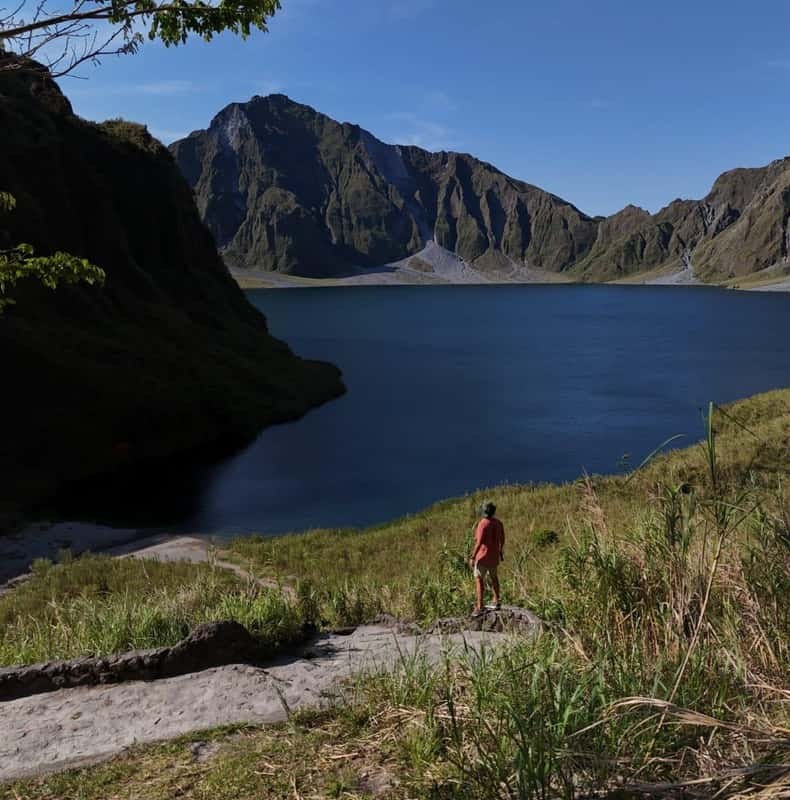
A Mount Pinatubo day is not difficult. It is long, it starts in the middle of the night, and almost none of it happens on a mountainside — you cross a plain of volcanic sand in an open jeep, walk up a riverbed for an hour or two, and arrive at a lake sitting in the hole the summit used to occupy. Knowing that shape in advance is most of what preparing for it involves.
Partly. You cannot drive yourself to the crater: the approach crosses an open riverbed that only the accredited 4x4 fleet is permitted on, and the jeep, the guide and the fees are arranged at the barangay registration desk when you arrive. What you can do is get yourself to that desk, hire the jeep and the guide there, and walk in. The Capas trail reopened on 23 June 2025 after a suspension over trail maintenance and ancestral-domain matters, and access now runs through operators accredited by the local government.
What stops most people is the clock rather than the rules. The registration and jeep dispatch happen at first light, which means leaving Metro Manila somewhere between midnight and three in the morning, driving three hours north and staying awake for the walk. That is the practical case for a Mount Pinatubo tour from Manila: the fare is largely buying you a driver who does that road every week and a seat that is already registered when you get there.
Five named places, and only two of them are on the same road.
| Where you go | What is there | How you get there | Time you get |
|---|---|---|---|
| Barangay Santa Juliana, Capas | Registration desk, 4x4 dispatch, homestays | 3 hours by road from Metro Manila, about 1 from Clark | 30–60 minutes |
| Crow Valley and the lahar flats | Open ash plain and eroded canyon walls | 4x4 only, from the jump-off | 1–3 hours in the jeep |
| The riverbed trail | Boulders, shallow crossings, canyon walls | On foot from where the jeep stops | 1–2 hours each way |
| The crater rim and lakeshore | Lake Pinatubo inside the 1991 caldera | The end of the trail | 1–1.5 hours |
| Puning Hot Spring, Angeles City | Sand spa, mud pack, thermal pools | A different valley, its own 4x4 road | Most of a day |
Both of the crater tours that publish a timetable run the same shape, and the private day shifts it about three hours later. This is the shared departure's own schedule:
Twelve to fourteen hours door to door, of which six or seven are the road. Nobody enjoys reading that, and everybody who does the trip says the same thing afterwards: the drive is the price of the hour at the top. The full breakdown is in the hour-by-hour guide.
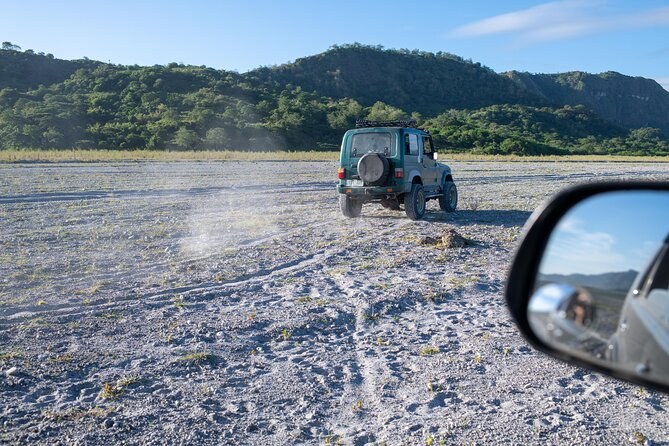
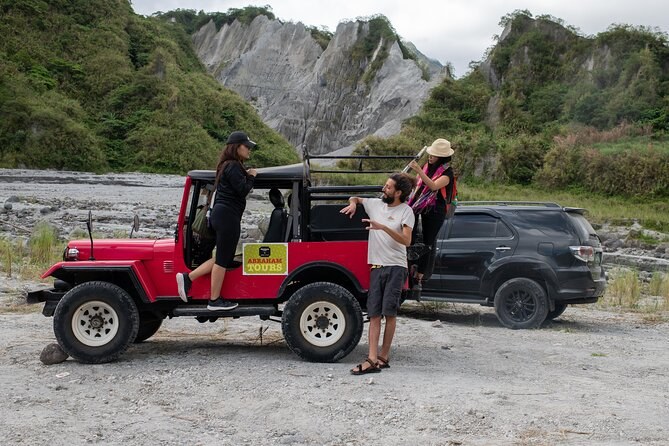
The 4x4 section is not a transfer, it is part of the attraction. You sit in an open-sided jeep and run for an hour or more across grey volcanic sand, through shallow river crossings and between canyon walls the 1991 mudflows carved out of the old mountainside. It is loud, bumpy and cold before sunrise, which is why every experienced reviewer says the same thing about a jacket.
What it is like: open sides, hard bench seats, no windows, five
passengers to a jeep on most operators.
What to expect: fine silica dust off the track, worse behind another
vehicle.
What helps: a buff or a light mask, sunglasses, and a jacket you can take
off at eight in the morning.
What changes it: water in the riverbed. In the dry months the jeeps get
much further up and the walk shortens.
Reviewers who have done it put the walk at three to five kilometres each way, taking one to two hours, with an optional 250-metre drop from the rim down to the water at the end. The gradient is gentle almost the whole way because you are walking up a valley floor rather than a slope. What makes it work is not fitness so much as footwear: the ground is loose rock and you will cross running water more than once.
The crater days carry the mountain fees inside the fare, and the private one itemises them: environmental fee, entrance fee, conservation fee. The amounts are set by the local government units, they change, and they are collected in cash at registration rather than online. That is why this site publishes the structure and not a figure: a peso number copied onto a travel page and left to age is worse than none.
Charged per jeep: the 4x4 and its driver, shared by the party in it.
Charged per group: the local guide who walks in with you.
Charged per person: the environmental and conservation fees taken at the
registration desk.
Charged on the spot, in cash: anything else — food, drinks, a
shower, a souvenir. There is no cash machine at the jump-off.
Most of the days here arrive with the jeep, the guide and the mountain fees prepaid, so the only cash you carry is for lunch.
This is a long day on loose ground in strong sun, and the listings are specific about who it does not suit: no wheelchair access on any of the four, and the shared crater day rules out travellers with back or heart conditions and asks for moderate fitness. The private hike sets a minimum age of ten. If any of that is you, the day that still works is the Puning Hot Spring trip, which uses the same 4x4 country on the Pampanga side and finishes in thermal pools instead of at a crater.
Trekking is a dry-season activity here. PAGASA puts the dry season at December to May and the rainy season at June to November, and the reason it matters is the riverbed: rain upstream raises the water the jeeps drive through and the walk crosses. Operators stand tours down when that happens, which is exactly what the 24-hour free-cancellation window on every one of these bookings is for. The month-by-month page has PAGASA's rainfall figures for the nearest station, and the rainy-season guide covers the half of the year most write-ups skip.
None of these tours is wheelchair accessible, and the crater days are unsuitable for back and heart conditions. The obstacle is the riverbed, not the vehicle. Getting to the jump-off covers the roads from Manila, Clark and Subic, and the questions people ask most covers the rest. Every departure is listed on Mount Pinatubo Tours.
From $101 per person
From $107 per person
From $382 per person